





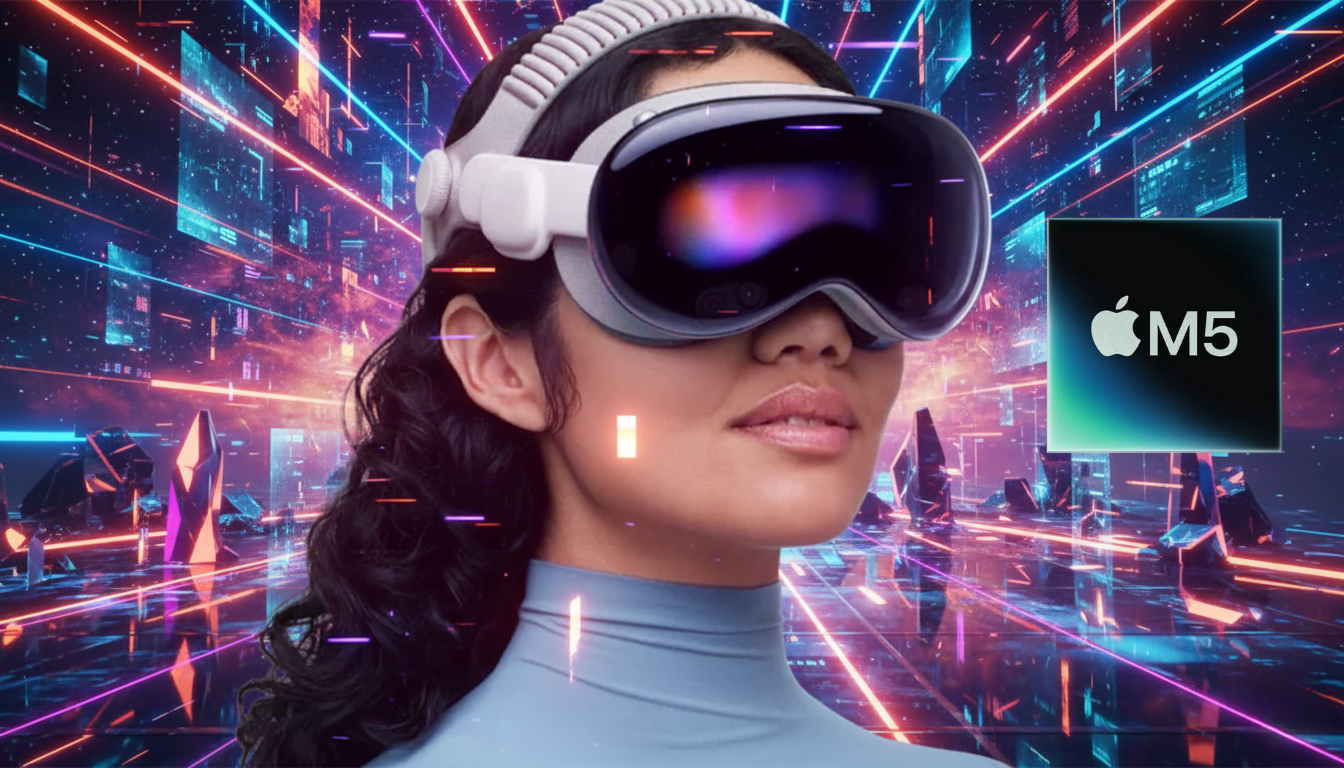
Apple has introduced the new Apple Vision Pro with the M5 chip. However, after a two-year hiatus, it has only now unveiled the second-generation model of the new Vision Pro. Those expecting a major revolution in the tech world were met with a modest update, a slight disappointment with almost no hardware changes beyond the M5 chip.
With the new Apple Vision Pro M5 price remaining fixed at $3,500, it has led to comments suggesting that Apple is slowing down its strategy.
What the M5 Chip Brings: Faster and More Efficient?
The most distinctive difference of the new Vision Pro lies at the very heart of the device. It is powered by Apple’s latest generation M5 processor. So what does this mean? What are its advantages? We can answer these questions by saying that the new chip provides faster app loading and approximately 20% longer battery life compared to the first M2-powered model. Furthermore, there’s a noticeable speed increase in tasks like converting standard photos into spatial scenes. While it’s not an incredibly fast speed, it can still be said to be an improvement over its predecessor.
However, these performance boosts are not at a level that would fundamentally change the daily experience. The device’s high-resolution micro-OLED displays, 12-camera sensor array, and even the outward-facing R1 chip come with the exact same hardware as the first model. This raises a question in our minds: Has Apple hit the brakes on the Vision Pro?
Has Apple Hit the Brakes on Vision Pro?
In response to this question, we can assume that Apple could not achieve its strategic goals with its previous device, and that Apple has different strategies for this area moving forward. Because, merely updating the M5 chip and making comfort changes after a two-year gap did not really satisfy users.
Comfort Criticism for Vision Pro Continues: Should the Solution Have Been a New Headband?
The most criticized aspect of the first Vision Pro model was its weight and the discomfort it caused during long-term use. This discomfort could become irritating in as little as 10 minutes. So, what did Apple do two years later with the new Apple Vision Pro M5 after these criticisms? Instead of solving the problem by making the device lighter, we see that it tried to overcome it by designing a new headband called the “dual knit band.”
Yes, this new band significantly increases comfort by better distributing the weight across the top and back of the head. An interesting detail is the addition of tungsten metal to the back of the band for balance. This actually makes the new model heavier on paper than its predecessor. In short, the new device is slightly heavier than the old one.
Apple has also made this new band available for purchase to existing Vision Pro users at a price of $99.
Why Has Apple Slowed Down? Has Apple’s New Path Evolved Towards Smart Glasses?


So, the real question is, “Why did Apple make such a minor update to its $3,500 flagship product?” The answer may lie in the market moving in an unexpected direction. While Samsung has launched its own virtual reality headset, the real rapid development is occurring in the smart glasses segment, like Meta Rayban.
Smart glasses like Meta Rayban, though offering far fewer capabilities than Vision Pro, have become more preferred. This is because they are glasses, aiming to provide the comfort of a hidden lifestyle technology. On the other hand, Apple offers a large and heavy device that is difficult to use in daily life and attracts attention. Which would you prefer?
Although smart glasses do not offer some of the advanced virtual reality experiences of Vision Pro, they reach a much wider audience due to their daily usability and “social acceptance.”
It appears that Apple has realized that Vision Pro is not a “massive success” appealing to a broad audience and that users primarily use the device for watching movies. Reports from the industry suggest that Apple has shelved a lighter “Vision Pro Air” model and is directly redirecting its resources to smart glasses development. Of course, these are just rumors and not yet confirmed facts. The tech giant Apple may be evolving towards making simple glasses smart, rather than shrinking powerful headsets.
So, what are your thoughts on this? Would you spend $3500 to buy the new Apple Vision Pro M5?


