



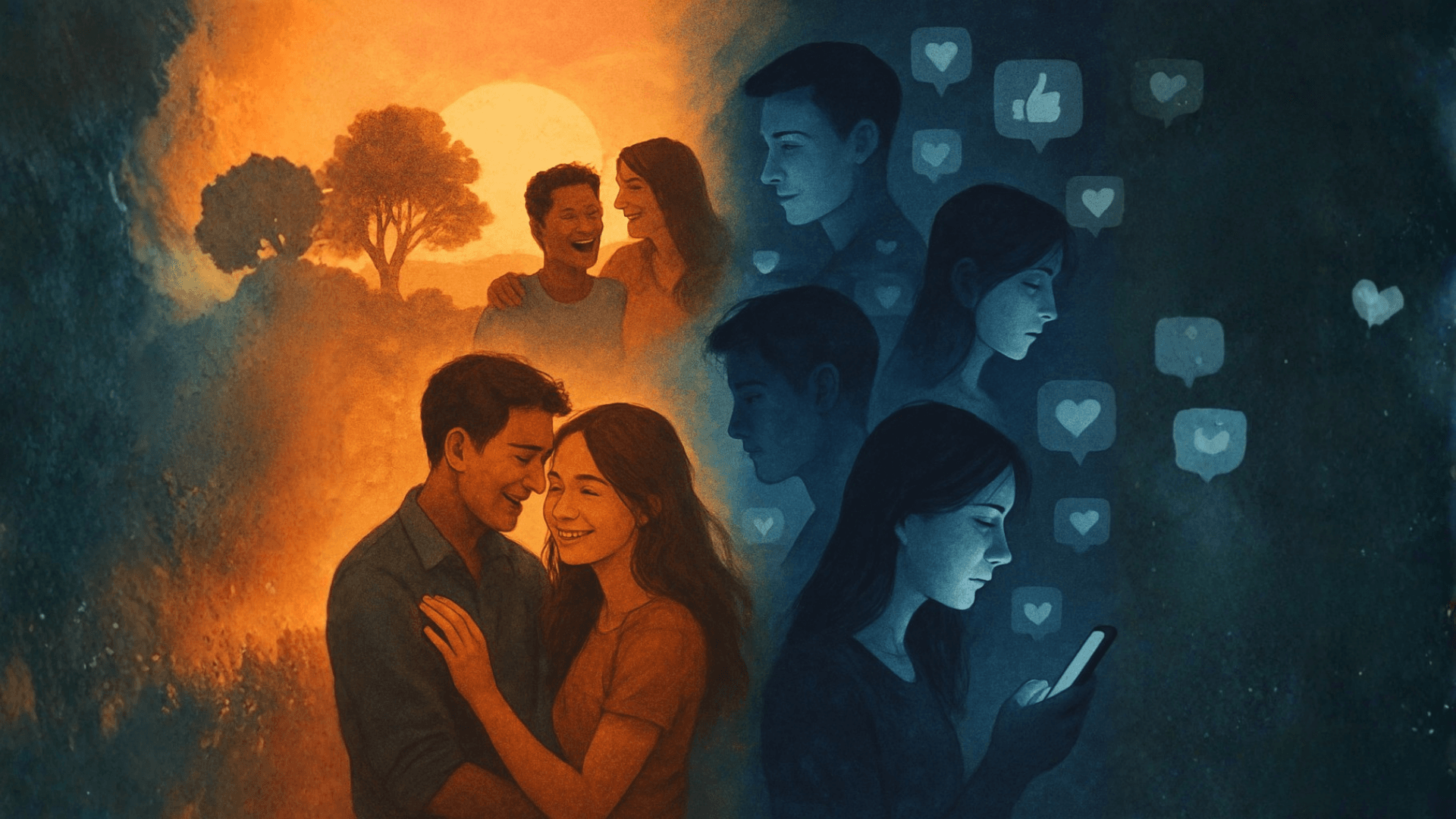
Our lives flow between two separate stages: one is the real face of the world, and the other is the digital realm we construct behind screens. And often, these two worlds not only intertwine but also upend human values like identity, personality, and character. How does social media shape friendships and love relationships?
Our friendships, our companionships, our loves, what we dream of, what we hope for, what we find, what we meet, what we can’t meet, and even our disappointments and longings are sometimes shaped by the invisible intervention of social media.
In a moment, we try to understand if a friend or acquaintance is doing well not by meeting face-to-face, but by a photo they shared on social media. We only realize their happiness or depressive states when we come together and gain information that way. Social media opened a beautiful door for our relationships and friendships. But it also allowed harmful rays to enter through that door. Previously, the principles of being a friend involved being together and spending quality time. While preferring to support each other through life’s ups and downs, now it’s about “blue ticks,” “seen” messages, “likes,” and being “online.”
The internet provides rapid, instant access to a lot of information in human relationships, in seconds. However, it weakens or cuts off the connections of the universe’s internet. That is, the connection with the creator is broken. While we get caught up in the delay of a message coming from someone, we miss the messages that would guide us to the truth in the divine system’s connection with us. Being in an expectation of instant news about everything reinforces feelings like impatience, distrust, and insatiability, and in relationships, it multiplies “what ifs,” carrying individuals to other stages.
As for love, which guides people to encounter beauty in life and opens the door to affection, social media shows ways to reach this value easily and end it even more easily. This is not inherently good or bad. It gains meaning depending on which window you look through and how you evaluate the matter.
If you are in a higher consciousness, this is considered a neutral, impartial, and non-judgmental situation for you. If you are in a lower consciousness, it becomes biased and judgmental gossip material on your agenda.
When an opportunity arose to meet someone at some point in life, we used to conduct long investigations, meet face-to-face, and either be sure or not sure with the information we gathered from them. Now, we can easily access information about a person on social media long beforehand. Photos on social media, happy or unhappy states, life stories, past relationships, what they like and dislike, and so on. In short, we can easily access this preliminary information about a person and satisfy our curiosity. And with these data, we can embark on a relationship. How accurate is this? It’s debatable.
Mask Culture on Social Media: The Conflict Between Real Identity and Digital Self
Being mysterious, researching, asking, learning, and being curious also lose their value in the process.
Social media taught people to exist with masks. Masks do not reflect reality. If you look in a mirror with a mask on, you cannot see your true face. And this is a deception. One who cannot see their true face in the mirror will encounter unreal, fake faces in life. This is a reflection of how you view life.
Social media is a medium, a neighborhood. You create how you want to live in this neighborhood. Therefore, if the situation and choices you created have turned into an unpleasant life, it is not the fault of the physical neighborhood. It is entirely a reflection of the negativity in your life energy. We can also consider this from a positive perspective.
Because these are the balances of life that exist in a neighborhood. The existence of positive needs negative, and the existence of negative needs positive.
Consequently, technology, which exists alongside humans, tends towards the direction that humans touch and guide it. At the same time, the way technology exists in life clearly reveals humanity’s worldview, intention, and purpose.
The Fake Happiness Race and Comparison Culture on Social Media
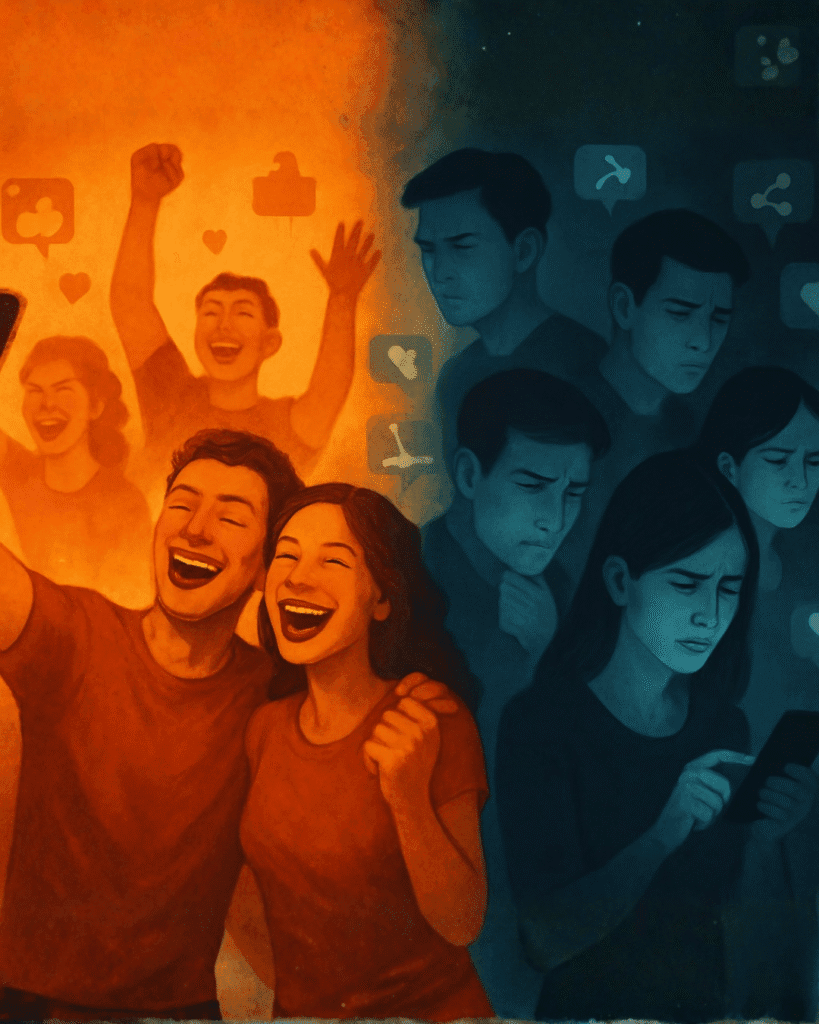
The invisible sense of competition created by social media brings a new definition to relationships. “Appearing happy” is the face on stage. If an individual or couple cannot present such an image, they begin to believe that their relationships reflect them as incomplete, crushed, or weak from the outside. And this can become a problem for them. These relationships, which seem perfect from the outside, can unconsciously create immense spiritual collapse within.
Comparisons, photos reflecting exaggerated smiles of screen personalities and couples, explorations in the depths of romance, even sharing their private moments that should belong only to them – even if they receive criticism, for a certain audience, the question “Why am I falling behind them?” can become a problem. Do we assume that what we see is reality? No, of course not. It cannot be. Because the grand, embellished, carefully selected media images and statements projected as something other than what is never reflect reality as it is. When these illusions, which the brain perceives as real, do not find their counterpart in life, the person comes to their senses with a severe blow. They end up with psychologists or psychiatrists. If they are not deeply asleep!
If we pay attention, social media can end a relationship just as it starts one. Mistakes in likes, account privacy, lovers who cannot break ties with the past, and those who project their sense of being with love stories onto the screen, comments. Suddenly, you might find yourself either excluded or removed from that online chat. Despite all this, we cannot ignore the beauties produced by social media. We cannot say that it completely harms relationships like friendship, companionship, love, and affection. We can see that it provides useful services in these areas, brings distant people closer, and alleviates longings, even if only slightly. It even offers opportunities for freedom and equality, as well as giving individuals the ability to express themselves. It allows connection with groups and individuals. Therefore, social media and the technology related to it are directly proportional to how we position it.
From Information to State: Life Beyond Filters
In conclusion; We cannot pluck and eat a cucumber or tomato we grow in the virtual world from its branch. We cannot smell its aroma, taste its flavor, or enjoy its deliciousness. We cannot touch the soil and release our negative energy. Perhaps we can gain knowledge about how to grow them. Yes, we can. But let’s always remember that knowledge is useless unless it transforms into a state of being. The relationship between a state of being and its manifestation is that one gives birth to the other.
That is, for someone whose state is paradise, their neighborhood also becomes paradise. Therefore, when we transform the digital into a state of being, we use the world and its beauties as a means for our relationships. Because no filter can replace the warmth in a person’s eyes. No “story” can convey the beauty and depth of a conversation. And no “like”
Can give the feeling and healing power of real communication and contact.
Socialization is a manifestation of human nature. Humans have been experiencing such a process since their existence. This is a state of need. This is the ground where the balance of giving and receiving will find existence in life. We are just facing a new form today. What is important is to accept the way this form exists in life. To be able to use it in harmony with our own existence, serving ourselves. So come on; Be among those who can manage themselves, who create their self in the moment.
Let’s be those who are content with their existence, who produce for the benefit of humanity, who both receive and give benefit, and who always meet technological developments with love, affection, peace, and happiness.
